Your Cart is Empty


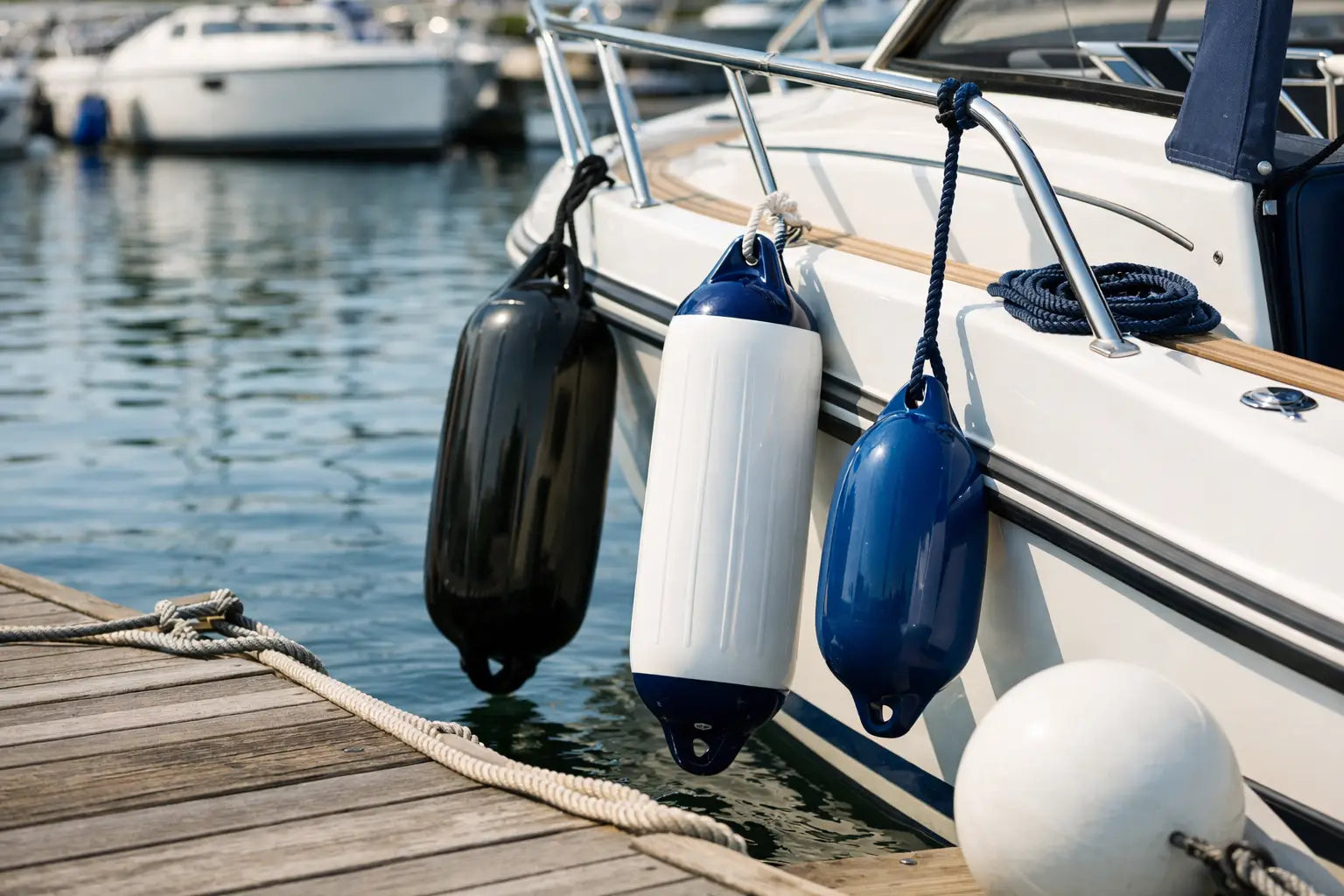

A fender that is too small can look fine right up until a gust pushes your boat hard against a piling. Then the dock hardware, not the fender, takes the hit. If you are asking what size boat fenders you need, start with your boat’s length, then factor in its weight, hull shape, home dock, and the conditions where you tie up.
The goal is simple: keep your hull clear of hard surfaces when the water gets moving. Choosing a slightly larger fender is usually cheaper than repairing gelcoat, rub rail, paint, or a damaged rail fitting.
For standard cylindrical boat fenders, a reliable starting rule is to choose about 1 inch of fender diameter for every 4 to 5 feet of boat length. Fender length should generally be about twice the diameter.
That puts many common recreational boats in this range:
| Boat length | Typical cylindrical fender size |
|---|---|
| 15 to 20 feet | 5 x 20 inches |
| 20 to 25 feet | 6.5 x 23 inches |
| 25 to 30 feet | 8 x 26 inches |
| 30 to 40 feet | 10 x 30 inches |
| 40 to 50 feet | 12 x 34 inches |
These are practical baseline sizes, not hard limits. A lightweight 22-foot runabout on a calm freshwater lake may be well served by 6.5-inch fenders. A 22-foot cabin boat with a higher profile, heavier displacement, and an exposed marina slip may need 8-inch fenders instead.
When you are between sizes, go up. Larger fenders provide more air volume and more cushioning, which matters when wakes roll through, wind loads the boat against the dock, or another vessel passes too close at the fuel pier.
Length overall gives you a fast sizing answer, but it does not tell the full docking story. A wide pontoon, a deep-V fishing boat, and a narrow sailboat of the same length can need different protection.
Heavier boats carry more momentum when they drift or swing into a dock. They benefit from larger-diameter fenders that can absorb the load without compressing flat. Windage matters, too. A boat with a hardtop, cabin, tower, or enclosed helm can get pushed around more easily in crosswinds, even if it is not especially heavy.
If your boat is heavy for its length or catches a lot of wind, size up one step from the basic chart.
Your fenders work best when they rest at the point where the boat is most likely to contact the dock. On many boats, that means setting the fender so its center is near the rub rail or slightly below it. A tall-sided pontoon boat or cabin cruiser may need longer fenders to reach the dock face correctly.
A short fender on a tall hull can ride above the dock edge. That leaves the hull exposed just when you need protection most. Check your boat at the dock rather than guessing from the trailer or driveway.
Calm, floating docks are easy on fenders. Fixed docks, rough water, tidal areas, pilings, seawalls, and busy marinas are not. A fixed dock can meet the hull at a changing height as water levels rise and fall, while a piling concentrates contact in one narrow area.
For tough conditions, use larger fenders and add coverage rather than relying on a single fender per side. More protection gives you more margin when a docking approach is less than perfect.
Most boat owners should begin with cylindrical fenders. They hang vertically or horizontally, cover a useful section of hull, and work well for everyday docking in slips, alongside a pier, or at a restaurant dock. Their shape makes them the most versatile choice for runabouts, pontoons, fishing boats, cruisers, and many sailboats.
Round fenders, often called ball fenders, are a smart addition when you need more concentrated protection. They are especially useful at pilings, lock walls, bow contact points, or places where wakes make the boat surge against a small area. A round fender does not replace a full set of cylindrical fenders for most boats, but it can solve a specific problem very well.
Center-hole fenders are convenient for boaters who want to rig lines quickly through the middle. Ribbed or non-ribbed styles are largely a matter of preference, though ribs can reduce rolling against certain dock surfaces. The critical decision is still size, inflation, and placement.
Two fenders are the bare minimum for a quick stop, but they are rarely enough for regular docking. For most boats under 30 feet, carry at least four cylindrical fenders. This lets you protect the bow quarter, midship area, and stern where contact is most likely, while keeping one available for the side that needs it.
Boats over 30 feet, boats with long hull sides, and boats kept in rough slips often need five or six. Add a round fender if you routinely tie to pilings, lock through, raft up, or dock beside uneven surfaces.
A practical onboard setup includes:
Even the right size fender will not help if it hangs in the wrong place. Before approaching a dock, lower the fender so the bottom reaches slightly below the dock’s contact edge. On a floating dock, the fender often stays at a consistent height relative to the boat. On a fixed dock, you may need to adjust it as water level, wake action, or the boat’s load changes.
Place the first fender near the widest part of the boat. This is commonly around midship, where the hull will touch first when you come alongside. Position additional fenders forward and aft based on the dock layout. If a piling is the risk, put the fender exactly where the piling will meet the hull, not several feet away where it looks more balanced.
Avoid tying fenders so tightly that they cannot move or compress. Use secure knots or adjustable fender clips, but leave the fender free to do its job. It should hang vertically for most docks and horizontally when protecting against a low dock edge, seawall, or another boat.
A firm fender is not necessarily a better fender. Overinflation reduces its ability to cushion an impact and can stress seams when temperatures climb. Most vinyl fenders should feel firm but still yield slightly when squeezed by hand.
Inflate fenders according to the manufacturer’s recommendation. If the boat has been sitting in cold weather and the day warms quickly, check them again. Air expands with heat, and a fender that felt right in the morning can become overly hard by afternoon.
Also inspect fender lines, eyelets, and valve areas before the season starts. A dependable fender is only useful if it stays attached when the dock gets rough.
A trailer boat that spends most days at a quiet launch ramp needs a different setup than a boat kept in a windy coastal slip. If you raft up with friends, fish from marina docks, stop at waterfront restaurants, or run rivers with lock walls, your fender kit needs to cover those situations.
For everyday use, buy the correct cylindrical size for your boat length, then add capacity for the conditions you actually face. That is a practical way to protect your boat without loading every storage compartment with gear you will never use.
Before your next outing, hang your fenders at the slip and look at them from the dock. A few minutes of adjustment before leaving the marina can keep a hard surface from becoming the most expensive part of your day on the water.