Your Cart is Empty



A calm morning at the launch can turn stressful fast when a kayak shifts overhead, a strap starts humming in the wind, or you realize your vehicle roof was never meant to handle the load. The good news: can roof racks carry kayaks? In most cases, yes - as long as the rack system, vehicle, carrier, and tie-down method are matched to the boat you are hauling.
A kayak is not just another piece of cargo. It catches wind, extends beyond the vehicle, and can become dangerous if it is secured with guesswork. A few checks before you load up can make the drive safer, quieter, and much easier.
Roof racks can safely carry kayaks when their dynamic weight rating is higher than the combined weight of your kayak, carrier, crossbars, and any other gear on the roof. Dynamic capacity is the limit while the vehicle is moving. It is the number that matters for highway driving, rough roads, braking, and crosswinds.
Do not rely on one rating alone. Your setup is only as strong as its lowest-rated part. The vehicle roof may have a 165-pound limit, for example, while the factory crossbars are rated for less. A carrier, mounting hardware, or aftermarket rack can also have its own limit. Follow the lowest number in the system.
Most recreational kayaks weigh roughly 35 to 80 pounds, so a single kayak is within the capacity of many factory and aftermarket roof rack systems. Tandem boats, fishing kayaks, pedal kayaks, and heavily accessorized rigs can be much heavier. Two kayaks may fit physically on the crossbars but still exceed the vehicle's roof-load rating.
Check your owner's manual for the vehicle's roof capacity and your rack manufacturer's instructions for crossbar and carrier limits. If the numbers are unclear, do not make assumptions based on how sturdy the rack looks.
The weight printed on a kayak's spec sheet is usually the bare-hull weight. Your travel weight may be higher once you add a seat, fishing crate, battery, rod holders, anchor, cart, dry bags, or other accessories. Remove loose gear before transport whenever possible. It protects the kayak and keeps items from becoming road hazards.
Then account for the hardware on the roof. A pair of crossbars, J-cradles, foam pads, and mounting clamps may add 15 to 30 pounds or more. That total has to stay below the roof's dynamic rating.
Length matters as much as weight. A 12-foot kayak can overhang the front and rear of a compact SUV considerably. That is normal, but long boats need bow and stern tie-downs to prevent movement at speed. Local and state rules may also require a red flag or light when cargo extends beyond the rear of the vehicle. Check the requirements for the states on your route before heading out.
The right carrier makes loading easier and keeps the hull supported in the way its manufacturer recommends. The best choice depends on your kayak's shape, weight, and how often you travel.
J-cradles hold a kayak on its side at an angle, leaving room for a second boat on wider crossbars. They are a practical option for recreational and touring kayaks, especially if you regularly paddle with a partner. The trade-off is loading height. Lifting a heavier kayak into a J-cradle on a tall truck or SUV can be awkward without a loading assist or a second person.
Saddle-style carriers support the hull from below. They are often a smart match for heavier fishing kayaks or boats with shaped hulls that should not be cinched tightly on their side. Because the boat sits lower and flatter, saddles can also reduce wind resistance compared with an upright carrier.
Stackers are vertical posts that let you carry narrow kayaks on edge. They can be efficient for multiple boats, but they demand careful strapping and are not ideal for every hull design. Foam blocks can work for occasional local trips on a bare roof, but they are a basic solution with more room for movement and roof damage. For frequent highway travel, solid crossbars and a dedicated carrier are the more dependable choice.
Before lifting the boat, park on level ground and inspect every component. Make sure crossbars are locked, carrier bolts are tight, straps have no fraying, and buckles are free of cracks. Keep cam straps clean and dry so grit does not wear through the webbing.
Set the kayak in the carrier with the cockpit facing down or up according to the carrier and kayak manufacturer's directions. Center it from side to side. A slight forward position can be fine if it improves support, but avoid placing all the weight behind the rear crossbar.
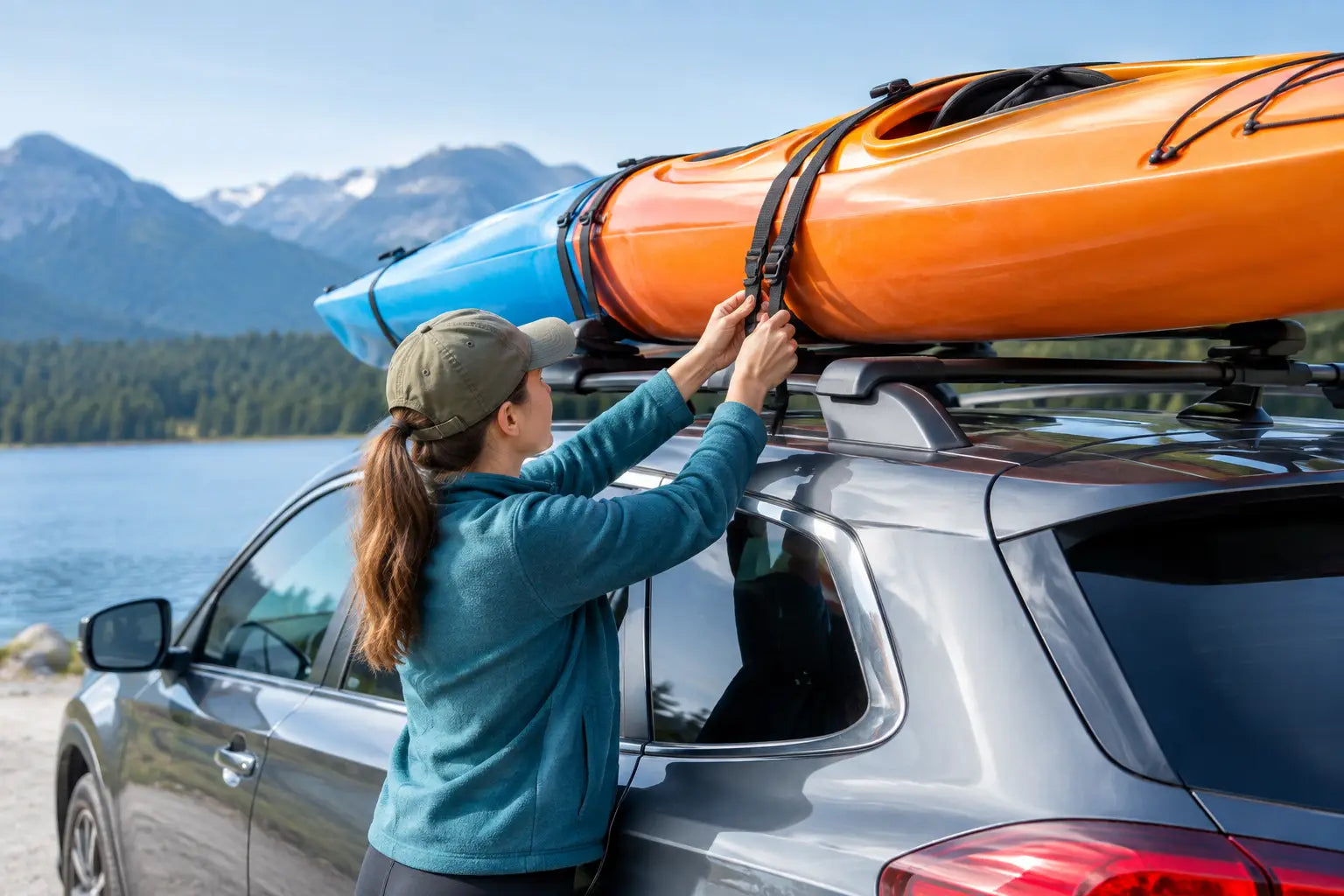
Run cam straps around the crossbars or through the carrier's designated strap points, then over the kayak. Do not wrap straps around removable rack accessories or rely on plastic parts not designed for load bearing. Tighten the straps until the kayak cannot shift, but do not crank them down hard enough to dent, flatten, or distort the hull.
Twist each strap once or twice before securing the loose end. That simple step helps prevent the loud flutter that can distract you for miles. Tie off excess webbing so it cannot whip against the vehicle or work loose.
Use bow and stern lines on longer boats, highway trips, or whenever you expect wind. These lines should stabilize the kayak rather than pull it tightly toward the bumper. Attach them to dedicated tow points or secure hood-loop anchors, not to weak plastic trim. At the stern, use a solid tow point or frame-mounted attachment point when available.
After everything is secured, grab the kayak near the bow and stern and give it a firm shake. The vehicle should move with the boat. If the kayak slides, rocks independently, or shifts in the carrier, adjust the straps before you drive.
A kayak on the roof changes how your vehicle handles. Expect more wind noise, slightly lower fuel economy, and greater sensitivity to gusts from open fields, bridges, passing semis, and bad weather. Slow down when conditions call for it, leave extra braking distance, and take corners smoothly.
Stop after the first 10 to 15 minutes of driving to recheck the straps and lines. Webbing can settle after the kayak meets highway wind. On longer trips, inspect the setup at every fuel stop or whenever road conditions get rough.
Avoid automatic car washes and low-clearance garages with a loaded roof. The kayak may sit higher than you think, especially in J-cradles. It also helps to place a note on the steering wheel that says “KAYAK ON ROOF” before you leave the launch. It is a simple reminder after a long paddle.
Roof transport is not the right answer for every boat or vehicle. A very heavy fishing kayak may be within the rack's capacity but still be unsafe or frustrating for one person to lift overhead. A pickup bed extender, small utility trailer, or kayak trailer may be the better fit for frequent transport.
The same goes for vehicles with no approved rack system, damaged roof rails, or a low roof-load limit. Do not improvise with rope through open windows or straps around door frames as a substitute for a rated rack. Saving a little money is not worth risking your kayak, vehicle, or the drivers around you.
A good roof rack setup gives you freedom to chase quiet coves, moving water, and early bites without turning the drive into the hardest part of the trip. Match the gear to your vehicle and boat, check it every time, and get outside with confidence.