Your Cart is Empty




A fish finder earns its place on the boat when it answers the questions that matter: How deep is it here? Is that a weed edge, a rock pile, or a school of bait? Where did we catch fish last time? A good fish finder review should help you match those answers to the water you fish, not just point you toward the unit with the biggest screen.
For a weekend angler on a small aluminum boat, a compact sonar unit with GPS can be a major upgrade. For tournament-minded anglers running larger rigs, side imaging, live sonar compatibility, and a networked display may be worth the added cost. The right choice depends on your boat, your target species, and how much information you will actually use once the bite turns on.
The most useful fish finder is not necessarily the most expensive one. It is the one you can see clearly, operate quickly, and trust when you are moving into unfamiliar water before daylight.
Start with the type of fishing you do most. Anglers working farm ponds, shallow creeks, and small lakes usually benefit more from straightforward 2D sonar and mapping than from high-end imaging. If you spend long days on big reservoirs, coastal bays, or the Great Lakes, extra screen space, stronger GPS features, and detailed structure imaging become far more valuable.
A dependable setup comes down to four core areas: sonar performance, display quality, navigation, and installation. Get those right, and you will spend less time adjusting menus and more time making productive casts.
Traditional 2D sonar remains the foundation of most fish finders for good reason. It shows depth, bottom contour, cover, baitfish, and fish targets in a simple scrolling display. It is especially useful for tracking your boat over points, humps, creek channels, and drop-offs.
Look for clear target separation if you fish around brush piles or suspended schools. Better separation makes it easier to tell whether you are seeing one fish, several fish, or bait stacked close to cover. Frequency also matters. Higher frequencies offer more detail in shallower water, while lower frequencies can reach deeper water with a wider cone angle.
Do not expect traditional sonar to identify every fish with certainty. Fish arches can vary with boat speed, transducer angle, and how a fish moves through the sonar cone. Learn to read the bottom, bait, and cover first. Those clues often put you in the right area even when fish marks are faint.
Down imaging creates a more photo-like view directly below the boat. It is excellent for confirming brush, standing timber, rock transitions, bridge pilings, and other hard structure. If you frequently fish vertical cover or want a better look at what sits beneath a waypoint, down imaging is a practical upgrade.
Side imaging scans outward from both sides of the boat, making it one of the fastest tools for searching flats, shorelines, channels, and offshore structure. Instead of driving directly over every target, you can cover broad water and spot likely areas from a distance. That saves time on larger lakes where finding the right stretch is half the battle.
There is a trade-off. Imaging sonar takes practice. The picture looks different depending on depth, range settings, boat speed, bottom composition, and water conditions. It also works best when the transducer is mounted cleanly and the boat is moving steadily. If you want simple depth readings and reliable navigation, you may not need it. If your goal is to find overlooked cover and map productive routes, it can change how you fish.
Live sonar shows movement in near real time, allowing anglers to watch fish, bait, and even their lure around the boat. It can be a serious advantage for forward-facing fishing, suspended fish, and open-water species such as crappie, bass, and striper.
It is also a bigger investment. The system may require a compatible display, separate transducer, mount, battery capacity, and time on the water to become useful. Live sonar is not a shortcut for poor boat control or weak location habits. Consider it after you have a solid GPS and sonar foundation, especially if you fish often enough to learn the system.
Screen size is one of the easiest features to underestimate. A 4- or 5-inch display can work well on a kayak, jon boat, or compact console, particularly when you are mainly checking depth and following a basic map. On larger boats, a 7-inch screen is often a comfortable starting point because it gives you room to view sonar and charts side by side.
A 9-inch or larger screen becomes useful when you run split views, side imaging, detailed contour maps, or multiple sonar sources. Bigger displays also make it easier to use touch controls while underway. Still, larger screens cost more, take up more dash space, and can demand more power.
Brightness matters as much as size. A screen that looks sharp in the garage may become difficult to read under direct summer sun. Choose a display built for daylight visibility, then place it where glare, spray, and a steering wheel will not block your view. Physical buttons are also worth considering if you fish in rain, wear gloves, or want quick control without looking down for long.
Sonar helps you find fish and structure. GPS helps you return to them. Even a basic built-in GPS is a valuable tool for marking brush piles, ramps, hazards, productive banks, and the exact turn into a creek arm.
Mapping quality varies by unit and chart option. Detailed contours are particularly helpful on reservoirs and large lakes, where a subtle ditch, point extension, or depth break may hold fish. On smaller waters, a simple map and accurate waypoint system can be all you need.
Think about the routes you run, too. If you fish before sunrise, return after dark, or navigate stump fields and shallow bays, GPS is a safety tool as well as a fishing tool. Save your tracks, mark hazards, and do not rely on electronics alone when water levels or weather conditions change.
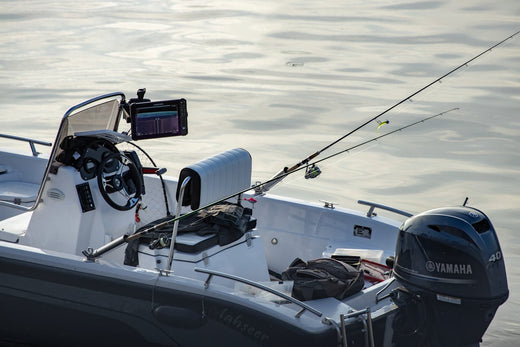
Before buying, measure the mounting area and decide how the unit will be used. A bow-mounted fish finder supports anglers who fish from the front deck and want sonar close at hand. A console unit is better for navigation and scanning while idling or running. Many serious boat setups use both, but one properly placed unit is better than two poorly installed ones.
Your transducer location is just as important. A transducer needs clean water flow to produce a reliable reading. Mounting it behind turbulent water, too close to a hull feature, or at the wrong angle can create lost depth readings and clutter at speed. Kayaks, pontoons, fiberglass boats, aluminum boats, and trolling-motor setups all call for different mounting considerations.
Check your battery capacity before adding larger displays, imaging modules, or live sonar. Electronics work best with steady, clean power. Loose wiring, weak batteries, undersized connectors, and poor fusing can create problems that look like sonar failures. Use marine-grade wiring practices, protect connections from moisture, and test the system at the dock before a long trip.
For the casual angler, a compact unit with traditional sonar, depth readings, and GPS waypoints delivers the best value. It keeps the setup simple and provides information you will use every outing.
For bass anglers and multi-species lake fishermen, a mid-size display with GPS mapping, down imaging, and possibly side imaging offers a strong balance of search power and price. It helps locate structure faster without adding a complicated network of equipment.
For offshore, big-water, and highly competitive anglers, larger network-capable displays can make sense. These setups support broader mapping, multiple transducers, radar or other compatible marine electronics, and specialized sonar views. Plan the full system before buying individual pieces so your screen, transducer, mounts, and power setup work together.
A fish finder should make the next trip more productive, not turn every launch into a troubleshooting session. Choose the clearest screen you can comfortably fit, prioritize sonar features that match your fishing style, and give GPS the attention it deserves. Outdoor Up helps anglers gear up with practical electronics and boating essentials built for real days on the water.
Then get out there and learn what your screen is telling you. Mark the good spots, compare what you see with what you catch, and let each trip build a better picture of the water beneath your boat.