Your Cart is Empty



A trolling motor that is too small will leave you fighting wind, current, and a loaded boat when you should be focused on the next cast. One that is oversized may cost more, add battery weight, and offer power you rarely use. Learning how to select trolling motor equipment starts with matching it to your boat, your water, and the way you fish.
A good setup does more than quietly move you from one spot to another. It helps you hold a shoreline, ease into shallow cover, work a dock without spooking fish, and stay in control when the weather picks up. Get the basics right, and your boat will feel easier to fish from all day.
The first question is not how much thrust you want. It is how much boat you need to move. Consider the fully loaded weight of the boat, including the motor, fuel, batteries, tackle, cooler, fishing partners, and any gear that normally comes along. A lightweight 12-foot jon boat has very different needs than a loaded bass boat or a 22-foot bay boat.
Trolling motor thrust is measured in pounds, and more thrust generally means better control. It does not mean the boat will run like it has a larger outboard. The benefit is the ability to move steadily and maintain position when wind, waves, or current are working against you.
As a practical starting point, small kayaks, canoes, and compact jon boats often work well with 30 to 45 pounds of thrust. Many aluminum fishing boats and bass boats need 50 to 80 pounds. Larger fiberglass boats, pontoons, and saltwater rigs commonly call for 80 to 112 pounds or more. These ranges are only a starting point, because hull design and fishing conditions matter just as much as length.
If you fish big reservoirs, tidal water, broad rivers, or open lakes where afternoon wind is normal, choose more thrust than the bare minimum. It is better to have reserve power available than to run a smaller motor at full output all day.
Thrust and battery voltage go together. Most trolling motors use a 12V, 24V, or 36V battery system. Higher-voltage motors usually provide more thrust and can be more efficient at moving larger boats, but they require additional batteries, charging capacity, and room in the boat.
A 12V motor is often the right fit for smaller boats and shorter outings. It keeps the system simple and affordable, which makes sense for a pond boat, kayak, or compact aluminum rig. A 24V system is a strong middle ground for many serious freshwater anglers. It provides the muscle needed for heavier boats and windy conditions without requiring a three-battery setup.
A 36V system is built for demanding use. If you fish larger boats, spend full days on the water, or regularly deal with current and rough weather, the extra power and runtime can be worth the added cost and battery space. Some premium motors use lithium-compatible systems or higher-voltage options, but the right choice still comes back to your boat and your typical trip.
Battery capacity matters too. A powerful motor cannot perform well with tired batteries. Deep-cycle marine batteries are designed for the repeated discharge and recharge cycles that trolling motors demand. Lithium batteries cost more upfront but can reduce weight, recharge faster, and offer useful runtime. Traditional lead-acid batteries remain a dependable value choice for many anglers.
Shaft length is one of the most overlooked parts of trolling motor selection. A motor can have plenty of thrust and still perform poorly if the propeller rides too close to the surface. In waves, it may break free of the water, lose thrust, and create extra noise.
Measure from the mounting point on the bow or transom straight down to the waterline. Then use the motor manufacturer's shaft-length guidance for that measurement. As a general rule, bow-mounted motors often need a 36-inch shaft on low-profile boats, a 45-inch shaft on many bass and aluminum boats, and a 52-inch shaft or longer on higher-sided boats. Offshore, bay, pontoon, and rough-water boats may need 60 inches or more.
When you are between sizes, the longer shaft is usually the safer choice for rough water. The trade-off is that a longer shaft can be less convenient to stow and may sit higher on the bow. Still, consistent prop depth is what gives you dependable control when conditions get choppy.
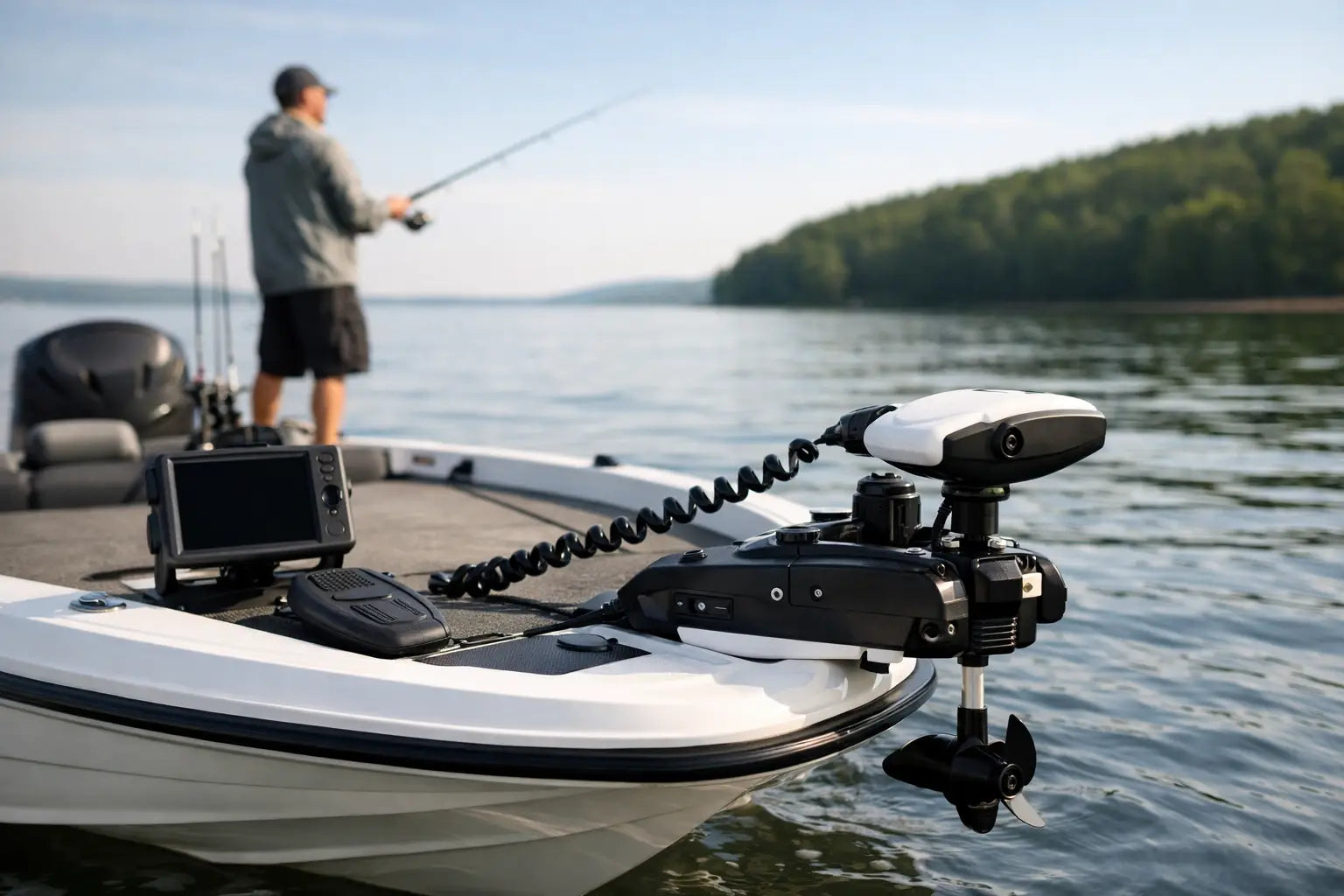
For fishing, a bow-mounted trolling motor is usually the best choice. Pulling the boat from the front gives you more precise control along banks, points, docks, and weed lines. It also lets you point the boat where you want to fish while making small corrections with a foot pedal or remote.
Transom-mounted motors are simple, compact, and practical for smaller boats. They are a smart option for jon boats, canoes, inflatable boats, and as a secondary motor. They can also be easier to install when your boat does not have a suitable bow mounting area.
The decision depends on how you use the boat. If you are casting to cover and need hands-free control, a bow mount is worth the investment. If you need quiet propulsion for a compact utility boat or occasional fishing trips, a transom mount can deliver excellent value.
Control style changes the entire experience. Hand-controlled motors are straightforward and dependable. They are ideal when you are close to the motor, especially on small boats. A tiller handle also keeps the price lower and makes basic operation easy for new boaters.
Foot pedals are a favorite for anglers who want to keep both hands on the rod. Cable-steer pedals offer immediate, direct steering response, which many bass anglers prefer for working tight cover. Electric-steer pedals are quieter and may pair with advanced features, though steering response can feel different from a cable system.
Remote control systems are a strong choice when you want to move freely around the boat. They can be especially useful on pontoons, multispecies boats, and rigs where several people fish at once. Some motors let you steer, adjust speed, and activate anchoring functions from a wireless remote or compatible electronics.
Advanced features can make a real difference, but only when they solve a problem you actually have. GPS anchoring, often called spot-lock style positioning, uses the motor to hold the boat near a selected location. It is valuable when fishing brush piles, offshore structure, bridge pilings, current seams, or windy points.
Built-in sonar integration can reduce clutter and help create a cleaner electronics setup. Heading lock can keep the boat moving in a consistent direction while you focus on casting. Auto-deploy and stow functions add convenience, especially on larger boats, but they also raise the budget.
For many anglers, the most useful upgrades are variable speed control, a quiet motor, a durable mount, and enough thrust for difficult conditions. Do not buy every feature because it sounds impressive. Put your money toward the capabilities that will help on your actual water.
A freshwater trolling motor should not automatically be used in saltwater. Saltwater-rated models use corrosion-resistant materials, protected electronics, and hardware designed to stand up to brackish and coastal conditions. Even then, rinse the motor with fresh water after every saltwater outing and inspect it regularly.
If you fish both environments, choose a saltwater-rated model from the beginning. It may cost more, but replacing a corroded freshwater motor is far more expensive than buying the right tool once.
Your trolling motor needs a reliable support system. Plan for properly sized batteries, a quality onboard charger, marine-grade wiring, circuit protection, and a secure mounting surface. Skipping these pieces can lead to weak performance, drained batteries, or avoidable electrical problems.
Before buying, confirm the motor's required voltage, maximum amp draw, shaft length, mounting pattern, and battery recommendations. Measure your available battery compartment and bow space rather than guessing. A motor that fits your fishing style but does not fit your boat is not a good deal.
The best trolling motor is the one that keeps you in control when the bite is on and the conditions turn against you. Choose enough thrust, enough shaft, and the right controls for your regular trips, then gear up with confidence and spend more time fishing where the fish live.