Your Cart is Empty


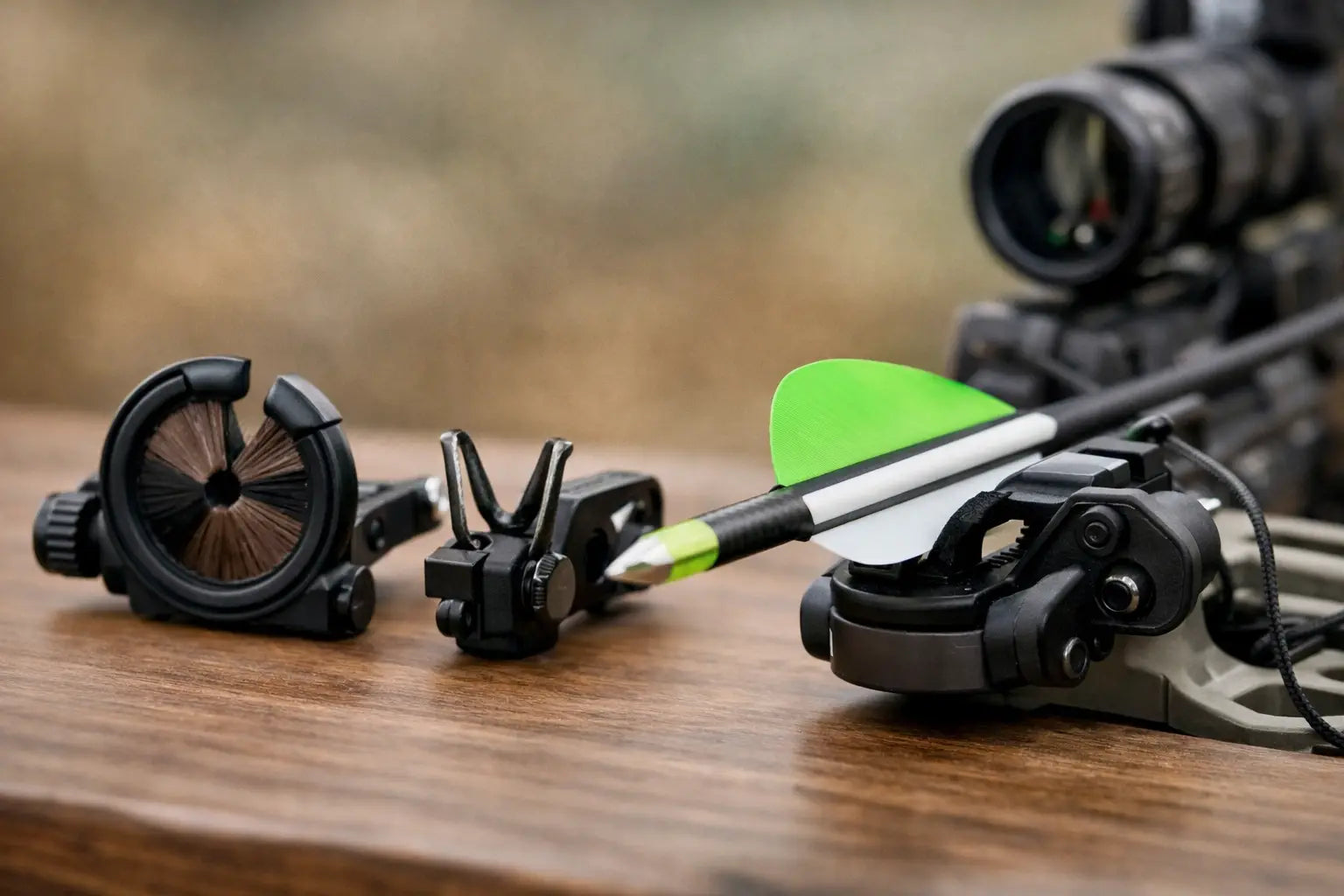

Miss left, then right, then high - and suddenly you start blaming the arrows. Sometimes the real issue is sitting right above the shelf. Arrow rest types explained in plain English can save a lot of frustration, especially if you're trying to match a bow setup to the way you actually shoot.
A good rest does one simple job: it supports the arrow consistently through the shot. The catch is that different rest designs do that in very different ways. Some prioritize forgiveness. Some favor speed and clean clearance. Some are built for hard-use hunting setups where reliability matters more than tiny gains on paper. If you're choosing between them, the best option depends on your bow, your experience level, and what happens when adrenaline shows up.
Most arrow rests fall into a few main categories: shoot-through rests, capture rests, drop-away rests, and blade rests. You'll also see specialty traditional rests, but for most compound shooters, the decision usually comes down to a whisker biscuit style capture rest, a drop-away, or a launcher/blade design.
The easiest way to think about them is this: how much contact does the rest keep with the arrow, and for how long? More contact often means more containment and easier handling. Less contact usually means better arrow clearance and potentially better accuracy, but it can ask more from the shooter and the setup.
A basic launcher rest holds the arrow on two prongs or a shaped support arm. The arrow sits on the rest and launches forward with relatively little contact. This style has been around a long time and still works well for many shooters.
The advantage is simplicity. Launcher rests can tune well, and they offer decent clearance if set up correctly. The trade-off is arrow security. If you're stalking, climbing, or drawing at odd angles, an uncaptured arrow can bounce off the rest at the worst possible moment.
For that reason, many hunters move away from simple launcher designs unless the rest includes some kind of containment arm or cage. For target shooters on a controlled range, that concern matters less.
Capture rests surround or heavily contain the arrow so it stays put while you move, draw, and aim. The most familiar version is the whisker biscuit. The arrow passes through bristles that hold it in place before and during the shot.
This is why whisker biscuit rests remain popular with bowhunters and new archers. They are easy to understand, easy to live with, and very forgiving in the field. If you are still building good shooting habits, having the arrow fully contained is a real benefit.
The downside is contact. Because the arrow passes through bristles, there is more drag than with a drop-away or blade rest. In many hunting setups, that small loss is worth it for the reliability. For a precision-focused shooter chasing every bit of consistency and speed, it may not be the first choice.
Another point in favor of this rest type is toughness. Capture rests tend to handle bumps, brush, and rough travel well. They are not complicated, and that matters when you're gearing up for a cold morning hunt and want fewer things to fuss with.
Drop-away rests support the arrow during the draw and then fall out of the way as the shot breaks. That gives the arrow excellent clearance, which is the main reason they are so common on modern compound hunting and target bows.
A well-tuned drop-away can deliver strong broadhead flight, good forgiveness, and a clean launch. For many archers, it hits the sweet spot between performance and practicality. You get containment on the draw with much less arrow contact at release.
There are two broad styles here: limb-driven and cable-driven. A cable-driven rest is connected to the bow's cables and times its movement that way. A limb-driven rest connects to a limb and often offers strong reliability and simpler tuning once installed correctly. Archers have opinions about both, and both can work very well.
The main trade-off is complexity. A drop-away has moving parts, timing considerations, and setup details that matter. If the rest is not installed well, you can run into clearance problems, inconsistent flight, or premature wear. It is not necessarily hard to own, but it rewards proper setup more than a biscuit does.
This is where "best" starts to depend on use.
If you are a newer archer, a casual backyard shooter, or a hunter who values simplicity above all, a capture rest is often the easiest recommendation. It keeps the arrow secure, reduces handling mistakes, and performs well enough for a wide range of hunting distances.
If you are a serious bowhunter who wants broadhead-friendly flight and better clearance, a drop-away rest usually makes more sense. It offers a strong mix of containment and performance, especially on modern compounds.
If you are focused on target archery, especially indoor spots or outdoor competition, launcher and blade styles become more attractive. They allow minimal arrow contact and fine tuning, but they are less forgiving of rough handling.
Blade rests are a specialized launcher style commonly used by target archers. Instead of a full arm or bristle containment system, they use a thin steel blade to support the arrow. The arrow flexes across the blade during launch, and the setup is designed for very clean clearance.
This type of rest is usually not the first choice for hunting. It can be extremely accurate in the right hands, but it is built for controlled conditions more than hard movement through woods, blinds, or uneven terrain. If your bow spends more time on the line than in the field, that trade-off may be perfect.
The biggest mistake is choosing based on hype instead of your actual use. A premium rest won't fix poor arrow spine, bad nocking point alignment, or inconsistent form. The rest is one part of the system.
Bow tune matters. Arrow fit matters. Broadhead choice matters if you hunt. Even how you carry your bow matters. A rest that looks ideal online can feel wrong fast if your arrow keeps slipping off during a slow draw from a treestand or if your timing starts drifting after heavy use.
Noise can matter too. Some rests are naturally quieter than others, and some become noisy only if neglected. In bowhunting, quiet operation counts. A rest that performs great on paper but clicks, rattles, or grabs at the wrong time is not helping you.
Durability is another practical factor. If your gear sees truck beds, backpacks, mud, brush, and weather, reliability should rank high. Outdoor Up customers usually want gear that works on real trips, not just gear that looks good on a spec sheet. In archery, that mindset pays off.
If you want the simplest path to dependable hunting performance, start with a whisker biscuit or similar capture rest. It is not flashy, but it works, and it keeps working.
If you already shoot well and want cleaner clearance for fixed-blade broadheads, a drop-away is often the upgrade worth making. Just plan on a careful install and tuning session.
If your focus is target scores and repeated precision in a controlled setting, a blade or launcher rest can be the better tool. You give up some field convenience in exchange for fine-tuned performance.
If you are buying a first bow package, it often makes sense to start simple. You can always upgrade later once you know what kind of shooting you do most. A rest is easier to choose when your habits are clear.
Traditional bows play by slightly different rules. Many recurves and longbows use shelf shooting or simple stick-on rests rather than compound-style systems. Feather fletching, shelf material, and shooting style all matter here, so the compound rest conversation does not always transfer cleanly.
If you shoot traditional, keep your rest choice matched to that bow style instead of borrowing advice meant for compounds.
If you are stuck between two options, ask a straightforward question: what problem am I trying to solve?
If the problem is arrow security, choose containment. If the problem is broadhead tuning and clearance, choose a drop-away. If the problem is squeezing out target performance, look toward launcher or blade designs.
Also be honest about setup confidence. Some archers enjoy tuning every detail. Others want to sight in, practice, and hunt. Neither approach is wrong, but each points toward a different rest type.
The right rest is the one that helps you shoot with fewer surprises when the moment matters. Keep it simple, match it to your style, and let your setup work for the kind of shots you actually take. That is how you get outside more and shoot with confidence.