Your Cart is Empty



You feel it the second you step inside. The floor leans, the fridge complains, the bed feels off, and suddenly a good campsite doesn’t feel so good. The best rv leveling tools fix that fast. They help you set up safer, sleep better, protect your appliances, and spend less time fiddling with your rig when you’d rather be outside.
Leveling an RV sounds simple until you hit a site with soft ground, uneven gravel, or a side-to-side slope that looks minor but feels huge once you’re parked. That’s why the right gear matters. Some tools are built for quick weekend trips. Others make more sense for heavier trailers, bigger motorhomes, or campers who move often and want a faster routine.
Good leveling gear has one job: make setup easier without adding hassle. In real use, that means more than just lifting a tire or raising a corner. The best tools should handle the weight of your rig, work on the surfaces you actually camp on, and stay simple enough to use after a long drive.
There’s also a difference between leveling and stabilizing, and it matters. Leveling gets your RV sitting flat. Stabilizing reduces movement after you’re parked. Some new RV owners buy stabilizer gear first and then wonder why their trailer still feels crooked. If your site is uneven, you need proper leveling gear before anything else.
The trade-off is that no single tool does everything perfectly. Stackable blocks are affordable and flexible, but they take more trial and error. Curved levelers are faster for many trailers, but they’re not ideal for every tire size or every weight class. Electronic systems are convenient, but they cost more and can be overkill for casual campers.
A basic bubble level is still one of the most useful pieces of RV setup gear you can own. It tells you what’s happening before you start pulling blocks out of storage, and it helps you make smaller, smarter corrections instead of guessing.
Stick-on side and front levels are especially useful for travel trailers because they let you check level from outside the rig. Small handheld levels work too, but mounted options save time at every campsite. They’re inexpensive, easy to use, and worth having even if you also use more advanced leveling systems.
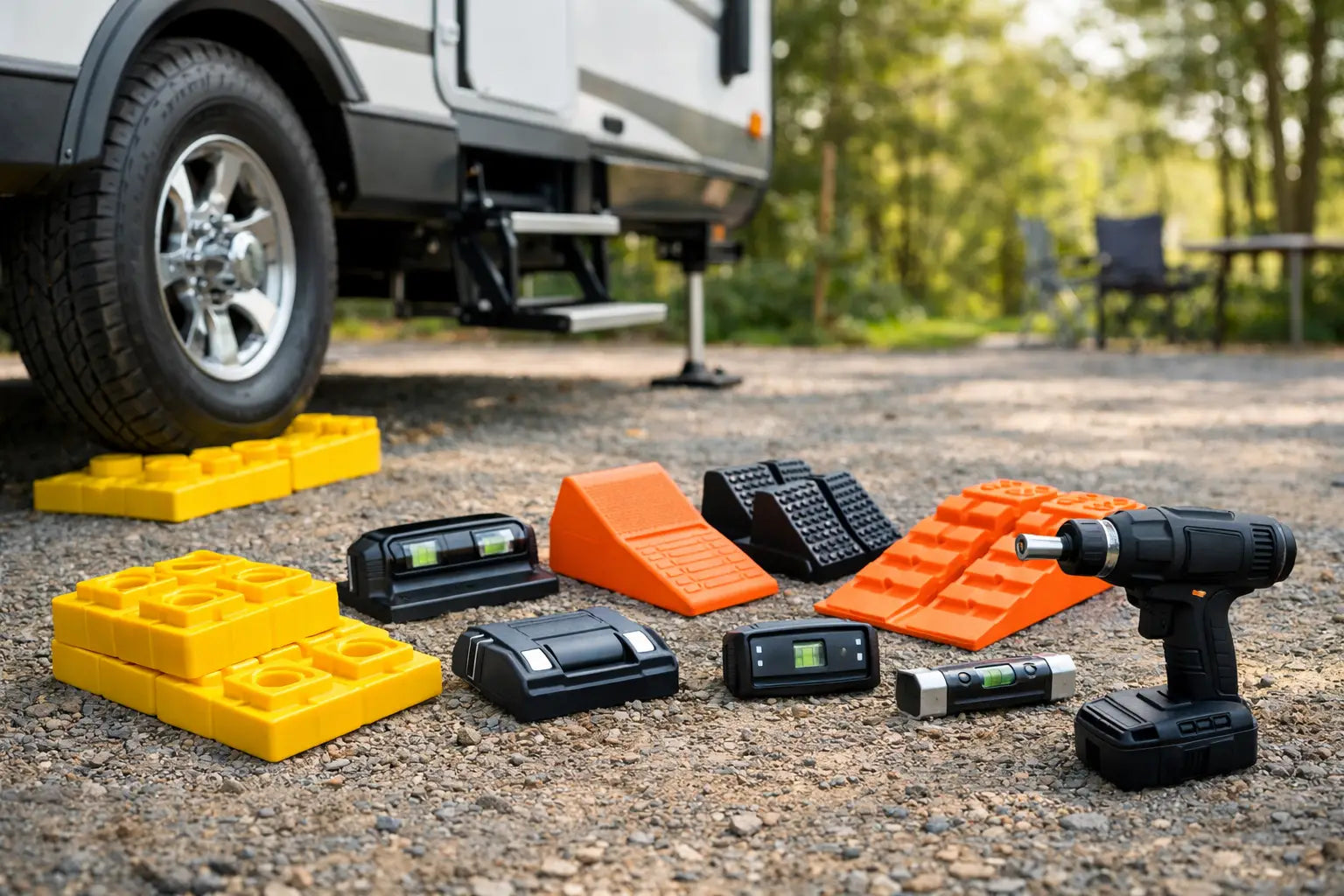
Stackable blocks are the classic choice for a reason. They’re affordable, easy to store, and adaptable to different campsite conditions. If you tow a travel trailer or small fifth wheel, they give you a lot of flexibility for side-to-side leveling and for supporting jacks on softer ground.
The downside is setup speed. You may need to back up, add another layer, and try again. On muddy or loose surfaces, they can also shift if you rush the process. Still, for many RV owners, these are the best value in the category because they work across so many situations.
Curved levelers have become a favorite for single-axle and tandem-axle trailer owners who want faster setup. Instead of stacking blocks, you roll the tire onto a curved ramp until the trailer reaches level, then lock it in place with a chock.
They’re convenient, quick, and easier to fine-tune than square blocks. That said, they’re not universal. Heavier rigs can push cheaper versions past their limits, and fit can vary depending on tire spacing. If you camp often and want a cleaner setup routine, though, this is one of the best RV leveling tools you can upgrade to.
Wheel chocks are not leveling tools in the strict sense, but they belong in every leveling setup. Once your RV is level, you need to keep it there. A good chock prevents rolling, improves stability, and gives you more confidence when you start unhooking or moving around inside the trailer.
For tandem-axle trailers, between-the-wheel chocks add another layer of stability by reducing front-to-back movement. Standard wedge chocks are simpler and more affordable, making them a smart choice for smaller trailers and occasional campers.
Front-to-back leveling often comes down to your tongue jack, and that jack works better with a solid base underneath it. Jack pads and blocks reduce sink-in on dirt, sand, and gravel, while also cutting down on how far the jack has to extend.
This is one of those small upgrades that pays off every trip. Less extension usually means better stability and less strain on the jack. If you camp in varied terrain, a sturdy pad is a practical piece of gear, not an extra.
If your RV uses manual stabilizer jacks, a drill adapter can make setup noticeably faster. It won’t level the RV by itself, but it streamlines the process once the rig is positioned correctly. After you’ve handled side-to-side and front-to-back leveling, you can drop the stabilizers in seconds instead of hand-cranking each one.
This tool matters most for campers who move often. If you’re doing quick overnight stops or frequent weekend trips, saving five or ten minutes at setup and breakdown starts to feel pretty valuable.
An electronic level takes the guesswork out of campsite setup. Some mount inside the RV and connect to an app, showing exactly how far off-level you are and which direction to correct. That can save repeat attempts, especially if you camp solo or regularly park on uneven sites.
These systems aren’t necessary for everyone. A bubble level and decent blocks can still get the job done. But if you want quicker, more repeatable setup with less back-and-forth, electronic indicators are one of the best RV leveling tools for convenience.
A trailer aid ramp is often bought for tire changes, but it can also help in certain leveling situations for tandem-axle trailers. By raising one tire, you may gain enough clearance or adjustment to improve positioning on mild uneven ground.
It’s more of a specialty tool than an everyday leveling essential. Still, if you run a tandem-axle trailer and like gear that serves more than one purpose, it’s a smart item to keep onboard.
If you own a larger fifth wheel or motorhome, automatic leveling systems are the premium option. Push a button, let the system do the work, and get on with camp setup. They’re hard to beat for speed and comfort, especially on bigger rigs where manual leveling gets old fast.
The trade-off is cost, plus added complexity. For many RV owners, an automatic system makes sense only if they travel often, camp for long stretches, or already have a higher-end setup. For everyone else, manual tools still offer better value.
Start with your RV type. Travel trailers and teardrops usually do well with bubble levels, blocks, curved levelers, and wheel chocks. Heavier fifth wheels may need tougher blocks, stronger chocks, and more attention to jack support. Motorhomes often benefit most from integrated hydraulic or electric leveling systems.
Then think about how you camp. If you stay at developed campgrounds with fairly even pads, you can keep your setup simple. If you boondock, park on forest roads, or use older campgrounds with rougher sites, you’ll want more adaptable gear with better ground support.
Frequency matters too. Occasional campers can get excellent results with affordable basics. Frequent travelers may want convenience upgrades that save time and reduce frustration. Spending a little more makes sense when you’re repeating the process dozens of times a season.
One of the biggest mistakes is trying to stabilize before the RV is level. Stabilizer jacks are not designed to lift and level the rig, and using them that way can lead to poor setup or even damage.
Another common problem is underestimating the ground surface. A tool that works well on concrete may struggle on loose gravel or wet soil. That’s why pads, blocks, and wide-contact accessories matter more than many campers expect.
It also helps to avoid buying the cheapest version of a high-load tool. Weight ratings are not marketing filler. If you have a larger trailer, choose leveling gear with enough capacity and a track record of holding up under real use.
For many campers, the sweet spot is simple. A mounted bubble level, a set of stackable blocks or curved levelers, solid wheel chocks, and a jack pad will cover most trips. That setup is affordable, easy to learn, and flexible enough for a wide range of campsites.
If you want to level faster, add an electronic indicator or drill adapter. If you’re towing a heavier rig, prioritize stronger construction and better chocking. The right combination depends less on finding one perfect product and more on building a setup that matches your RV, your terrain, and your camping style.
That’s the real goal with the best RV leveling tools - less setup stress, more time by the fire, and a campsite that feels right the moment you step inside.