Your Cart is Empty



A loose load can ruin a trip before you even hit the highway. Whether you're hauling an ATV to the trail, a kayak to the launch, or gear for a weekend campout, the right trailer tie down straps make the difference between confident towing and constant mirror-checking.
Most people shop straps by price first. That makes sense until a bargain strap frays early, slips under tension, or simply doesn't match the weight and shape of what you're hauling. Good straps are not just about keeping cargo in place. They help protect your gear, reduce movement that causes wear, and give you more control over the whole towing setup.
At the simplest level, a strap needs to hold cargo firmly enough that it won't shift under braking, turns, bumps, or crosswinds. But real-world hauling is rarely that simple. A side-by-side on a utility trailer behaves differently than lumber, coolers, or a small boat. Weight distribution, cargo shape, trailer style, and anchor point placement all change what kind of strap works best.
That is why there is no single best strap for every load. A lighter strap may work well for coolers, bins, and camping gear. A heavier ratchet strap with strong hardware is usually the better choice for motorcycles, lawn equipment, UTVs, and other dense loads that can build momentum if they move even slightly.
You also need the strap to work with your gear, not against it. Some loads need firm compression. Others need secure restraint without crushing or scratching the item. That trade-off matters more than many buyers expect.
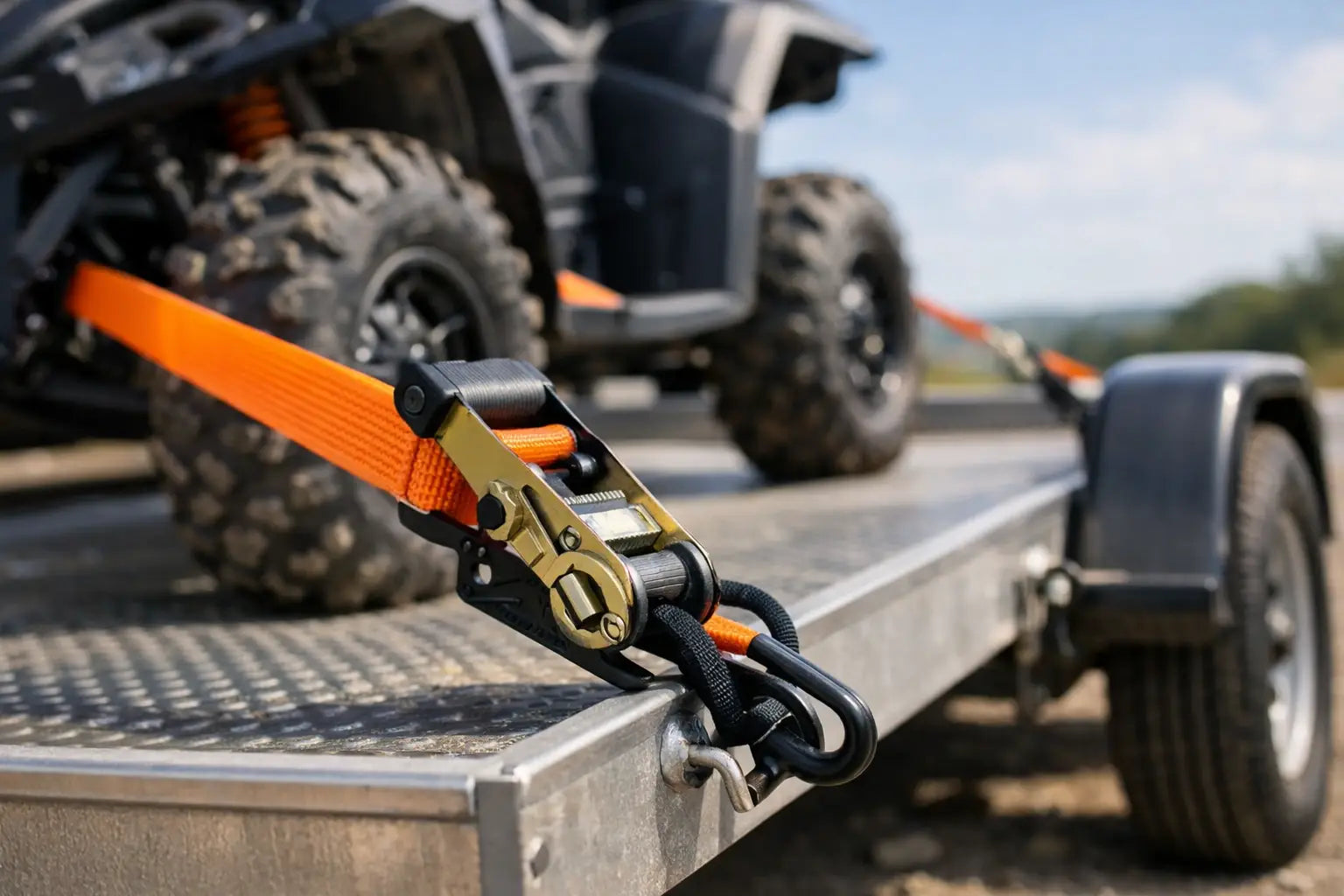
If you're deciding between ratchet and cam buckle straps, start with the load itself. Ratchet straps give you more tension and more holding power. They are the go-to choice for heavier cargo and for equipment with wheels, frames, or hard mounting points. They take a little longer to set up, but they are usually worth it when stability matters most.
Cam buckle straps are faster and easier to use. They are a strong option for lighter gear, especially when you want to avoid over-tightening. Kayaks, canoes, paddleboards, and some camping loads often pair well with cam straps because you can secure the gear firmly without cranking down too hard.
The downside is that cam buckle straps generally offer less tension and may not be ideal for heavy equipment on rough roads. Ratchet straps can solve that problem, but they also bring a risk of over-compression if used carelessly. If you have ever seen a dented fender, bent rail, or crushed cooler lid, you have seen that trade-off in action.
This is where buyers should slow down and read the label. The working load limit matters more than the advertised break strength. Break strength tells you the force at which the strap may fail. Working load limit is the safer number for actual use.
For practical buying, match the strap to the cargo and give yourself a margin. Heavier machines and denser equipment need more capacity than awkward but lightweight items. Width matters too. Wider straps usually spread pressure better and often provide more strength, which can help with stability and reduce wear on the cargo.
Hardware counts just as much as webbing. Hooks, flat hooks, D-rings, and snap hooks all fit different trailer anchor points. A strong strap with the wrong end fitting is still the wrong strap. If the hook doesn't seat properly or tends to twist under load, security drops fast.
Different adventures call for different hauling setups. If you're trailering an ATV or mower, ratchet straps with solid hooks and abrasion-resistant webbing are usually the smart play. These loads are heavy, compact, and likely to shift if not held tightly at multiple points.
For kayaks and canoes, cam buckle straps are often the better match. They secure the boat well without the excessive force that can deform a hull. Add bow and stern tie-downs when needed, especially for longer travel or higher speeds.
Motorcycles need extra attention because balance matters as much as strength. Many riders use ratchet straps with soft loops to avoid damaging handlebars or frames. The goal is controlled compression of the suspension, not flattening it. Too loose and the bike rocks. Too tight and you're putting unnecessary stress on components.
General cargo like totes, firewood, fishing gear, and camp supplies can go either way depending on the weight and how the trailer is loaded. In many cases, a mix of strap types works best. Heavier pieces get ratchet straps. Lighter items get cam straps or are grouped under a cargo net once the base load is locked down.
A strap that is too short is obviously a problem, but one that is too long can be just as annoying. Excess webbing flaps in the wind, gets dirty, and creates a mess around the trailer. The best setup gives you enough length to route cleanly with a little room for adjustment, not ten extra feet dragging near the deck.
Anchor point location shapes the entire job. You want angles that pull the cargo down and in, not just sideways. On wheeled equipment, four-point tie-downs usually provide better control than trying to do everything with two straps. On lighter gear, balanced placement helps reduce rubbing and keeps the load centered.
This is also where trailer style comes into play. An open utility trailer gives you different options than a boat trailer or enclosed trailer. Buyers sometimes focus heavily on strap specs and forget to check whether their trailer has the right anchor setup to use those straps effectively.
The webbing should feel thick, tightly woven, and ready for repeated use. Cheap webbing tends to fuzz, fray, and weaken sooner, especially with sun exposure and repeated abrasion. Stitching should look clean and reinforced, not sparse or uneven.
Ratchet mechanisms should operate smoothly without sticking or feeling flimsy. Good hardware gives you confidence when tensioning the load. Bad hardware feels questionable before you even leave the driveway.
Weather resistance matters too. Straps live hard lives. They deal with UV exposure, dirt, road spray, mud, and occasional neglect. If you haul often, durability is not a bonus feature. It's basic value. Paying a bit more for straps that last through multiple seasons usually costs less than replacing cheap ones over and over.
One of the biggest mistakes is using too few straps. Another is relying on one strong strap where two or four properly placed straps would control the load much better. Strength alone does not fix poor positioning.
Twisted straps are another common issue. Twists reduce surface contact and can create uneven tension. Sharp edges are just as risky. If the webbing is rubbing against metal corners or rough surfaces, wear can build fast unless you use edge protection or reroute the strap.
Then there is the habit of tightening once and forgetting it. New loads often settle during the first few miles. Checking strap tension after a short drive is a simple step that prevents a lot of problems later.
Start with what you haul most often, not what seems universally useful. If you regularly move powersports equipment, prioritize ratchet straps with higher working load limits and reliable hooks. If your routine leans toward kayaks, paddle gear, and lighter camp loads, cam buckle straps may cover more of your real needs.
Then think about frequency. Occasional haulers can get by with a simpler setup, but regular towing calls for better webbing, stronger hardware, and a few spare straps in the truck. This is one of those categories where convenience and readiness go together. Having the right strap on hand means less improvising at the trailhead, boat ramp, or campsite.
For many outdoor buyers, the best approach is building a small strap kit instead of chasing a one-size-fits-all answer. A couple of heavier ratchet straps, a few lighter straps, and soft loops or protective sleeves can handle a wide range of trips without overcomplicating the gear pile.
When you're gearing up for the next haul, think beyond getting cargo from point A to point B. The right trailer setup protects your equipment, saves time, and lets you tow with more confidence. That means fewer worries on the road and more focus on where you're headed next.