Your Cart is Empty


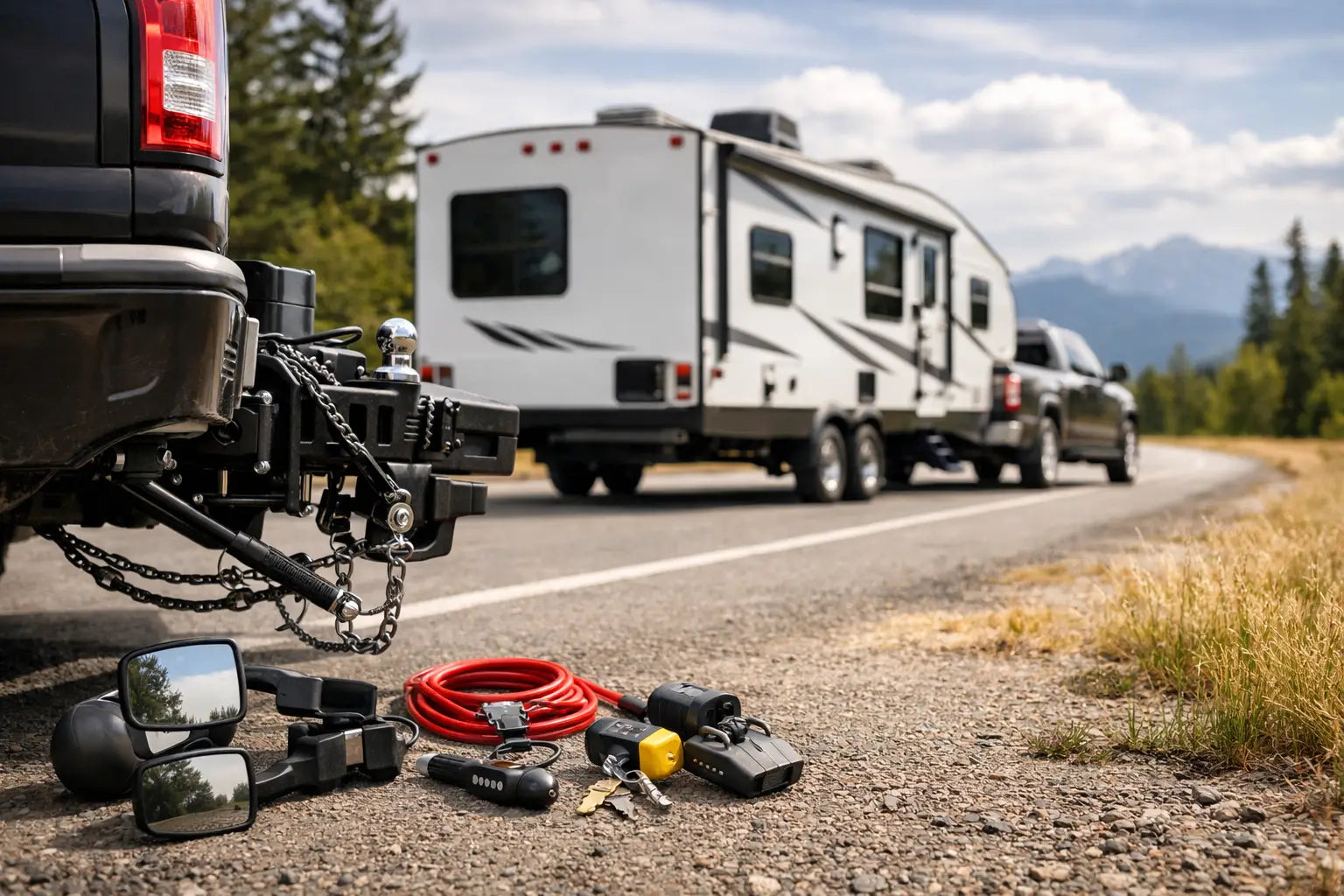

A trailer that feels settled at 65 mph starts with the gear between your tow vehicle and your RV. This RV towing accessories guide focuses on the equipment that helps prevent sway, protects your connection, improves braking control, and makes setup less stressful at the campground. The right accessory is not always the biggest or most expensive one. It is the one that matches your trailer, your tow vehicle, and the way you actually travel.
Before adding any towing accessory, confirm the numbers. Look at your trailer's loaded weight, tongue weight, gross vehicle weight rating, tow vehicle towing capacity, payload capacity, hitch receiver rating, and tire ratings. These limits work together. A truck may be rated to pull a trailer's total weight but run out of payload once passengers, a full fuel tank, cargo, and tongue weight are added.
Tongue weight usually lands around 10% to 15% of a conventional travel trailer's loaded weight, although your trailer manufacturer is the final authority. Too little tongue weight can make a trailer prone to sway. Too much can overload the rear axle, suspension, tires, or hitch. A tongue-weight scale is a practical accessory for dialing in cargo placement before a long trip.
Do not shop by trailer length alone. Two 28-foot trailers can have very different weights and towing behavior. Load the RV as you would for a real trip, then use actual scale weights whenever possible. That information makes every choice below more accurate.
Your hitch setup is the foundation. A properly rated ball mount, hitch ball, coupler lock, safety chains, breakaway system, and trailer wiring connection should be checked before every departure. These pieces may not get much attention until one fails, which is exactly why they deserve it.
Choose a ball mount and hitch ball rated above the trailer's fully loaded weight. The ball size must match the coupler exactly. Common sizes include 2 inches and 2-5/16 inches, but never assume. Check the coupler label and confirm that the ball shank fits the ball mount correctly.
A drop or rise ball mount helps keep the trailer level when connected. Level towing supports better handling and more even weight distribution. Measure from the ground to the top of the receiver opening and from the ground to the bottom of the level trailer coupler, then select the appropriate rise or drop. Recheck after loading because suspension squat can change the result.
A locking hitch pin secures the ball mount to the receiver, while a coupler lock adds theft deterrence when the trailer is parked. Locks are useful, but they do not replace a thorough connection check. Make sure the coupler is fully seated, latched, and pinned before pulling away.
For many travel trailers, a weight-distribution hitch is one of the most valuable upgrades you can make. It transfers part of the tongue weight from the rear axle of the tow vehicle toward the front axle and trailer axles. That can improve steering response, braking balance, and headlight aim.
Weight-distribution systems are not automatic requirements for every trailer. A small utility trailer or lightweight camper may tow well with a standard ball mount. On the other hand, a heavier travel trailer, a half-ton truck carrying passengers and gear, or a long route with crosswinds may benefit greatly. Follow the RV and tow vehicle manufacturers' guidance, especially if your vehicle has restrictions on weight-distribution use.
Sway control is related but separate. Some hitches include built-in sway control, while other setups use an add-on friction bar. Integrated systems are generally better suited to frequent towing and larger trailers. A friction bar can be a more affordable option for lighter setups, but it must be adjusted correctly and may need to be removed before backing or on slick surfaces, depending on its instructions.
No accessory can correct poor loading, excessive speed, worn tires, or a mismatched tow vehicle. Put heavier cargo low and near the trailer axles, keep the tongue weight in range, and slow down when wind or traffic picks up.
Safety chains are your backup connection if the coupler separates from the ball. Cross them under the coupler to create a cradle that can help keep the tongue from striking the road. They should have enough slack for turns but not so much that they drag. Use chains and hooks rated for the trailer, and replace damaged links, stretched hardware, or worn hooks.
Every trailer with electric brakes needs a working breakaway system. If the trailer separates from the tow vehicle, the breakaway cable pulls a pin that activates the trailer brakes. The cable should be attached independently to a solid point on the tow vehicle, not looped around the hitch ball or clipped to the safety chains. Check the battery, pin, cable, and switch housing regularly. A dead breakaway battery is a small problem that can turn serious fast.
Towing control depends on communication between your tow vehicle and trailer. That means a correctly adjusted brake controller, a clean wiring plug, and lights that work every time.
A proportional brake controller is a strong choice for electric trailer brakes because it applies braking force in relation to the tow vehicle's braking. Set the gain according to the controller instructions and test it in a clear area at low speed. The trailer should help slow the combination without locking its wheels or pushing the tow vehicle. Changes in trailer load, weather, and road conditions can call for small adjustments.
Carry a basic trailer wiring tester, spare fuses, electrical contact cleaner, and a few replacement bulbs if your trailer uses them. Before leaving, test running lights, turn signals, brake lights, reverse lights, and the trailer brake function. Corrosion, loose pins, and a cable that drags on pavement are common sources of trouble.
Extended towing mirrors deserve a place on the essentials list if the trailer blocks your rearward view. You need to see down both sides of the RV, not just the trailer's rear corners. Clamp-on mirror extensions can work well for occasional towing. Vehicle-specific towing mirrors usually offer a steadier, wider view for regular travelers.
Trailer tires have a hard job. They carry heavy loads, sit for long periods, and often run hot on summer pavement. A tire pressure monitoring system gives you early warning of a pressure loss or heat issue, potentially before a damaged tire takes out a fender, floor, or plumbing line. It is especially useful on long interstate runs and multi-axle trailers.
Check tire pressure when cold and use the pressure listed on the tire or trailer placard as directed by the manufacturer. Inspect sidewalls for cracking, tread for uneven wear, and lug nuts for proper torque. Bring a tire pressure gauge, portable inflator, lug wrench sized for your trailer, wheel chocks, and a roadside warning kit. A full-size spare in usable condition is far more helpful than a plan to find one on a holiday weekend.
At the campsite, wheel chocks should go down before unhitching. They keep the trailer from rolling while you set stabilizers, level the RV, or move around inside. Leveling blocks help correct side-to-side and front-to-back position without stacking random lumber or rocks. Choose blocks rated for the load and use them on stable ground.
Stabilizer pads can reduce sinking on soft ground, but remember that stabilizer jacks are not lifting jacks unless the manufacturer says otherwise. Use the right tool for a tire change or axle service. A jack designed for the required load, used at approved lifting points, is the safer route.
The best towing accessory is consistency. Build a walk-around routine and use it every time, even for a short move between sites. Check that steps are up, awnings are secured, compartments are latched, roof vents are closed, stabilizers are raised, antennas are down, and the campsite is clear.
At the hitch, verify the coupler latch and pin, chains, breakaway cable, wiring plug, jack position, and safety cables. Confirm that your trailer brakes and lights work, then look at the tires one more time. A bright inspection flashlight helps with early-morning departures, while work gloves keep greasy hitch hardware from becoming a messy start to the day.
Gear up for the trip you have planned, not the one you hope will be trouble-free. A solid hitch setup, dependable braking gear, visible lighting, and a simple check routine let you spend less time second-guessing the road and more time enjoying where it leads.